
QuiX Quantum Introduces PACU, a Photonic Assembly Control Unit For Scalable Quantum Systems
Understand this faster with AI


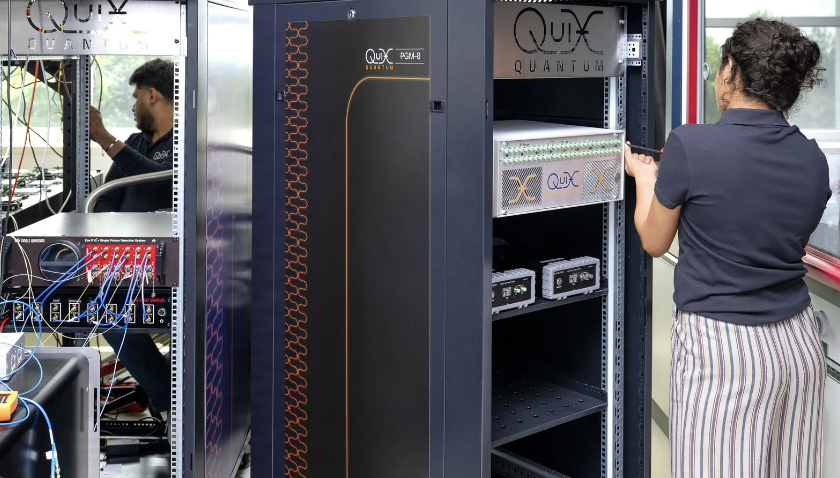
Insider Brief QuiX Quantum introduced PACU, a new Photonic Assembly Control Unit designed to provide a scalable and standardized control layer for its photonic quantum systems and future universal quantum computers. The rack-mountable PACU system supports up to 1,000 low-speed and 32 high-speed phase shifters, with features including sub-2 millisecond response times, Ethernet and USB connectivity, air cooling, overheat protection, and hot-swappable photonic assemblies. The company said PACU is intended to reduce operational complexity and improve modularity, maintenance, and data center integration as photonic quantum systems scale toward broader industrial and commercial applications. PRESS RELEASE — QuiX Quantum today introduced PACU, its new Photonic Assembly Control Unit designed to provide a scalable, standardized control layer for the company’s photonic quantum systems and future universal quantum computers. The unit is designed to host photonic chips with up to 1,000 low-speed and up to 32 high-speed phase shifters, giving QuiX Quantum the control infrastructure needed to operate complex universal photonic architectures and integrate that capability into a compact, rack-mountable system. A universal quantum computer is designed to run a broad set of quantum algorithms rather than being limited to a narrow class of tasks. For quantum hardware companies, universality is an important long-term goal because it points toward general-purpose quantum systems that can support a wider range of scientific, industrial and commercial applications. QuiX Quantum has positioned photonics as the basis for its universal quantum computing roadmap, with systems designed for modularity, data-center compatibility, and integration into hybrid quantum-classical computing environments. “As photonic quantum chips become more capable, the systems around them must scale as well,” said Stefan Hengesbach, CEO of QuiX Quantum. “PACU gives us a common control architecture across our photonic platform. It is designed to make our systems more modular, maintainable and ready for integration into larger quantum computing environments.” PACU addresses scalable and reliable control, one of the central engineering requirements in photonic quantum computing. Larger photonic quantum chips require control systems that can manage more tunable elements, maintain precision, simplify calibration, reduce operational complexity, and integrate into real-world compute environments. QuiX Quantum’s photonic systems are designed around integrated silicon nitride photonic chips and are intended to operate in data center and HPC settings, where footprint, serviceability and system stability are important deployment considerations. The new unit features a 3U, 19-inch rack-mount design, Ethernet and USB connectivity, air cooling, E2000 optical connectors, individual tunable-element control, overheat protection, and condition feedback from the photonic assembly to the control unit. PACU supports photonic assemblies with up to 1,000 low-speed phase shifters and can update all phase shifters with a response time of below 2 milliseconds. It also includes 32 high-speed connectors that allow the unit to interface with external high-speed control systems, a capability relevant for future measurement-based photonic quantum computing architectures. PACU improves on reproducibility, maintenance, and replacement workflows. Photonic assemblies can be connected through board-to-board connectors rather than flat cables, creating a more resilient interface and supporting hot-swappable operation. By combining rack-based integration, air cooling, monitoring, protection, and support for large photonic assemblies, PACU gives QuiX Quantum a repeatable control architecture for its current photonic chips and future universal quantum computing systems. The unit is intended to reduce operational complexity as systems scale, while supporting the modularity and serviceability required for deployment outside of laboratory environments.
Matt Swayne LinkedIn With a several-decades long background in journalism and communications, Matt Swayne has worked as a science communicator for an R1 university for more than 12 years, specializing in translating high tech and deep tech for the general audience. He has served as a writer, editor and analyst at The Quantum Insider since its inception. In addition to his service as a science communicator, Matt also develops courses to improve the media and communications skills of scientists and has taught courses. matt@thequantuminsider.com Share this article:
Tags
Source Information
Discussion
0 professional contributions
Sign in to join this professional discussion.
Be the first to add a constructive contribution.